
















Vitamin D3 is not called the "sunshine vitamin" for nothing: Your skin produces it as soon as sunlight hits it. But in large parts of Europe, this is difficult for a large part of the year, and that is where supplementation comes into play.
Here you will read what vitamin D3 exactly is, what it is good for, how much you need, how to recognize a deficiency and what to look for when choosing a supplement. Factual and without exaggerated promises.
Topics in this article
- What is vitamin D3?
- What is vitamin D3 good for?
- How do you get vitamin D3?
- Why especially in winter?
- Recognizing a deficiency
- How much vitamin D3 per day?
- Which vitamin D3 do you choose?
- Frequently asked questions
- Conclusion
What is vitamin D3?
Vitamin D3, also known as cholecalciferol, is a fat-soluble vitamin. There are two forms: vitamin D2 (ergocalciferol, from plants and mushrooms) and vitamin D3 (cholecalciferol, mainly from animal sources and what your skin produces itself). D3 is the form that the body uses most easily and that you find in most supplements.
The special thing about vitamin D is that it behaves more like a hormone in the body than a classic vitamin. Your skin produces it under the influence of UV-B from sunlight, after which the liver and kidneys convert it into the active form. This also explains why sunlight plays such a big role.
What is vitamin D3 good for?
For vitamin D, unlike many other substances, there are officially approved health claims. The most important:
- Vitamin D contributes to the maintenance of normal bones.
- Vitamin D contributes to a normal function of the immune system.
- Vitamin D contributes to the maintenance of normal muscle function.
- Vitamin D contributes to the maintenance of normal teeth.
- Vitamin D contributes to a normal absorption and utilization of calcium and phosphorus.
- Vitamin D has a function in cell division.
In short, vitamin D3 is mainly about your bones, muscles, teeth and your immune system, with calcium as the common thread: Without sufficient vitamin D, your body absorbs calcium less effectively.
How do you get vitamin D3?
There are roughly three ways to get vitamin D3.
- Sunlight: the most important source. With sufficient sun, your skin produces a decent amount in about ten to thirty minutes. How this works depends on your skin type, the season and how much skin is uncovered.
- Diet: Vitamin D3 is mainly found in fatty fish (salmon, mackerel, herring), egg yolk and liver. Through diet alone, you usually only cover a limited part of your needs.
- Supplements: practical when sun and diet provide too little, especially in the winter half of the year. In the vitamin D3 collection you will find various dosages and forms.
Why especially in winter?
From about October to March, the sun stands too low in the sky to let enough UV-B through. Your skin can then hardly produce vitamin D3, no matter how often you go outside. In addition, we spend more time indoors in winter and wear more covering clothing.

The result is that the vitamin D supply you built up in the summer slowly decreases. For many people, this is exactly the reason to take a supplement in the winter half of the year. Read more about this in our post about the importance of vitamin D3 in winter.
Recognizing a deficiency
A vitamin D deficiency develops gradually and does not always give clear signals. Reported symptoms include fatigue, a less powerful feeling in the muscles and bone complaints. Some groups have a higher risk: people with darker skin, older people, people who rarely go outside, and people who wear a lot of covering clothing.
Are you in doubt? Only a blood test through your family doctor provides real certainty about your vitamin D status. Read more about this in our post about vitamin D deficiency.
How much vitamin D3 per day?
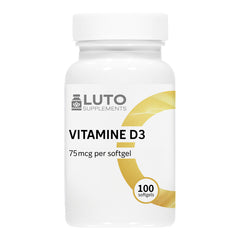
The right amount depends on age, skin type and situation. On supplements, you often see vitamin D in two units: micrograms (µg) and international units (IE or IU). The conversion is simple: 1 microgram corresponds to 40 IU. A supplement with 75 µg is therefore 3000 IU.
In stores, you will see dosages from around 25 µg (1000 IU) up to high-dose variants of 125 µg (5000 IU). The DGE states an estimated value of 20 µg (800 IU) per day in the absence of body-produced formation. Stick to the dosage on the packaging and speak with your family doctor in case of doubt or a proven deficiency. Do not take significantly more than recommended long-term, as vitamin D is fat-soluble and accumulates in the body.
Which vitamin D3 do you choose?
Dosage that suits your situation
Choose a dosage that suits your goal: a maintenance dose for the winter half of the year like the NOW Foods Vitamin D3 2000 IU or a higher dosage like the NOW Foods Vitamin D3 5000 IU, if there is a reason for it.
Combination with vitamin K2
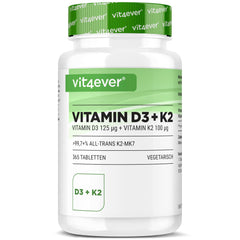
Vitamin D3 and K2 are often combined. Where D3 helps with the absorption of calcium, K2 plays a role in where this calcium ends up. If you want both in one supplement, check out the NOW Foods Vitamin D3 & K2 or the Vitamin D3 + K2 collection.
As pure as possible
Look for a short list of ingredients and make sure that origin and dosage are clearly stated. Look at the entire range in the vitamin D3 collection.
Frequently asked questions about vitamin D3
What is the difference between vitamin D2 and D3?
D2 (ergocalciferol) comes from plants and mushrooms, D3 (cholecalciferol) mainly from animal sources and your own skin. D3 is the form that the body uses most easily.
How much is 1000 IU in micrograms?
1000 IU corresponds to 25 micrograms. The conversion is: 1 microgram is 40 IU.
Can I stop taking vitamin D3 in summer?
If you go outside enough in the summer, your skin produces vitamin D3 itself. However, some groups are advised to supplement all year round. Speak with your family doctor in case of doubt.
Why vitamin D3 together with K2?
D3 contributes to the absorption of calcium; K2 plays a role in where this calcium ends up in the body. That is why they are often combined in one supplement.
Can you take too much vitamin D3?
Yes. Since vitamin D is fat-soluble, an excess accumulates. Therefore, stay within the recommended dosage and do not take high doses long-term without consulting a doctor.
Conclusion
Vitamin D3 is a fat-soluble vitamin with a clear role for bones, muscles, teeth and the immune system, with calcium as the common thread. Your skin produces it from sunlight, but in the winter half of the year, this is hardly possible, and then a supplement is a logical addition.
Do you want to choose a vitamin D3 yourself? Compare the dosages and forms in the vitamin D3 collection or look at a D3 + K2 combination.

