Glucosamin 1500 mg LUTO Supplements – Produkt | kaufen in Deutschland und Österreich
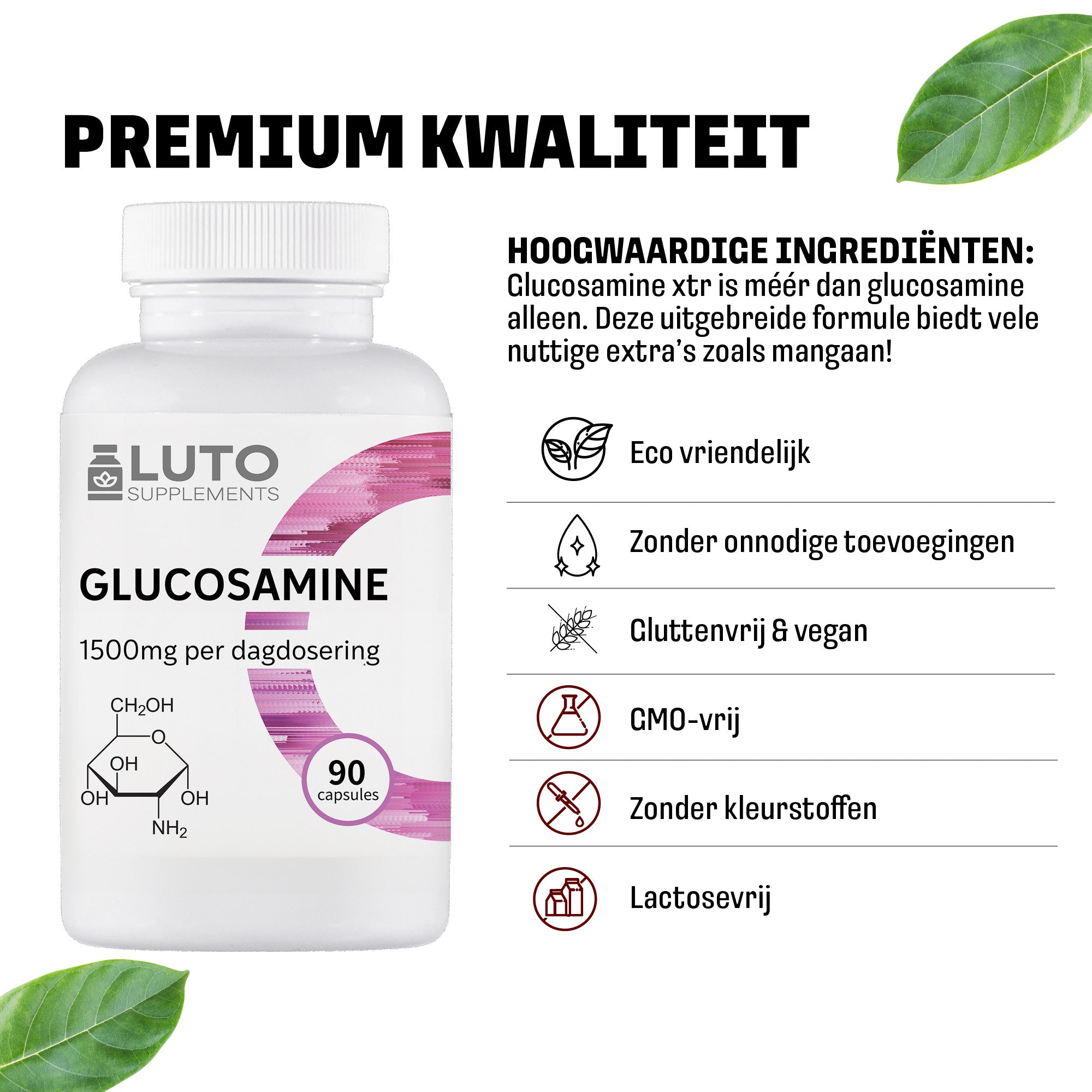
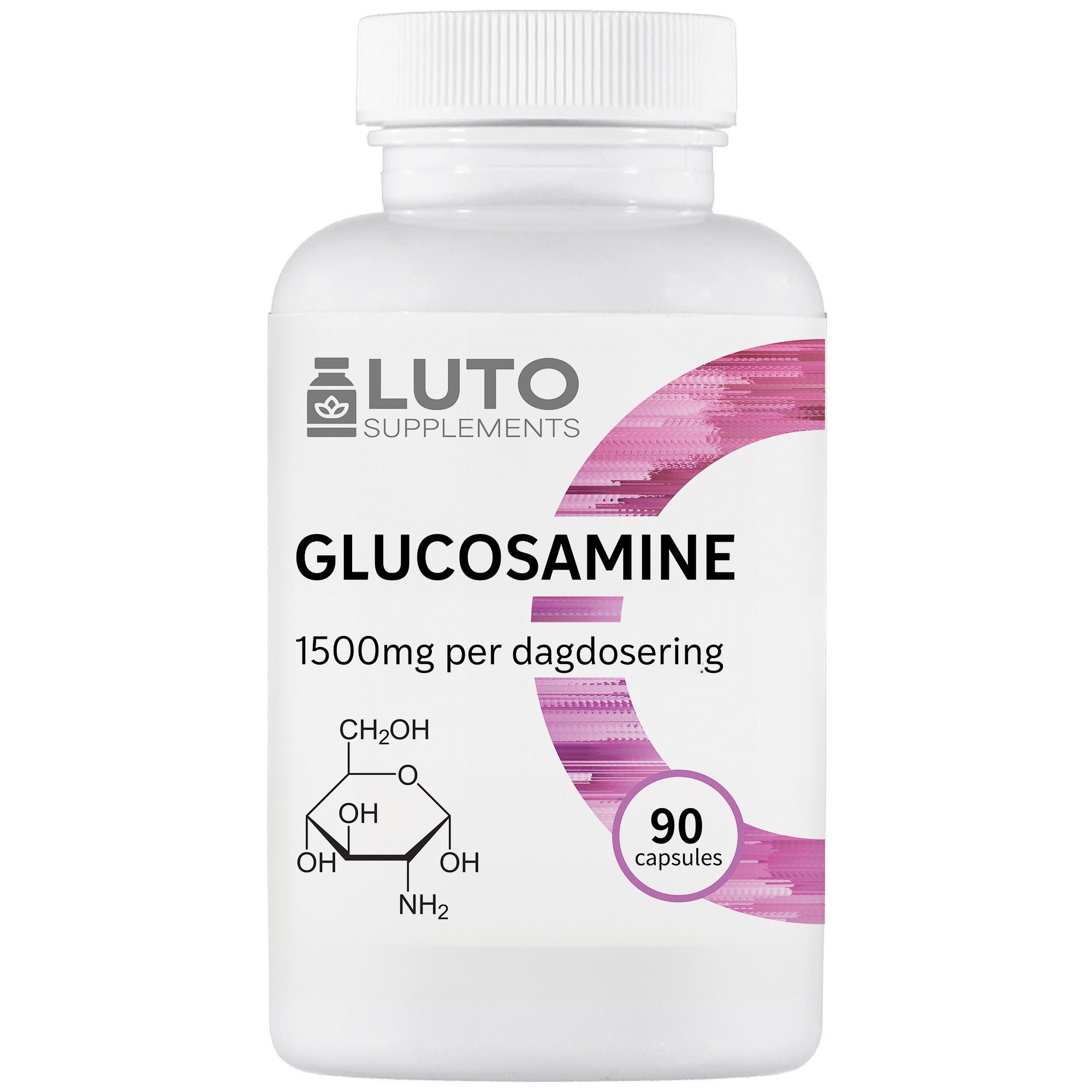
Glucosamin 1500 mg LUTO Supplements – Produktverpackung Vorderseite
Glucosamin 1500 mg LUTO Supplements – Verpackung mit Etikett und Produktinformationen
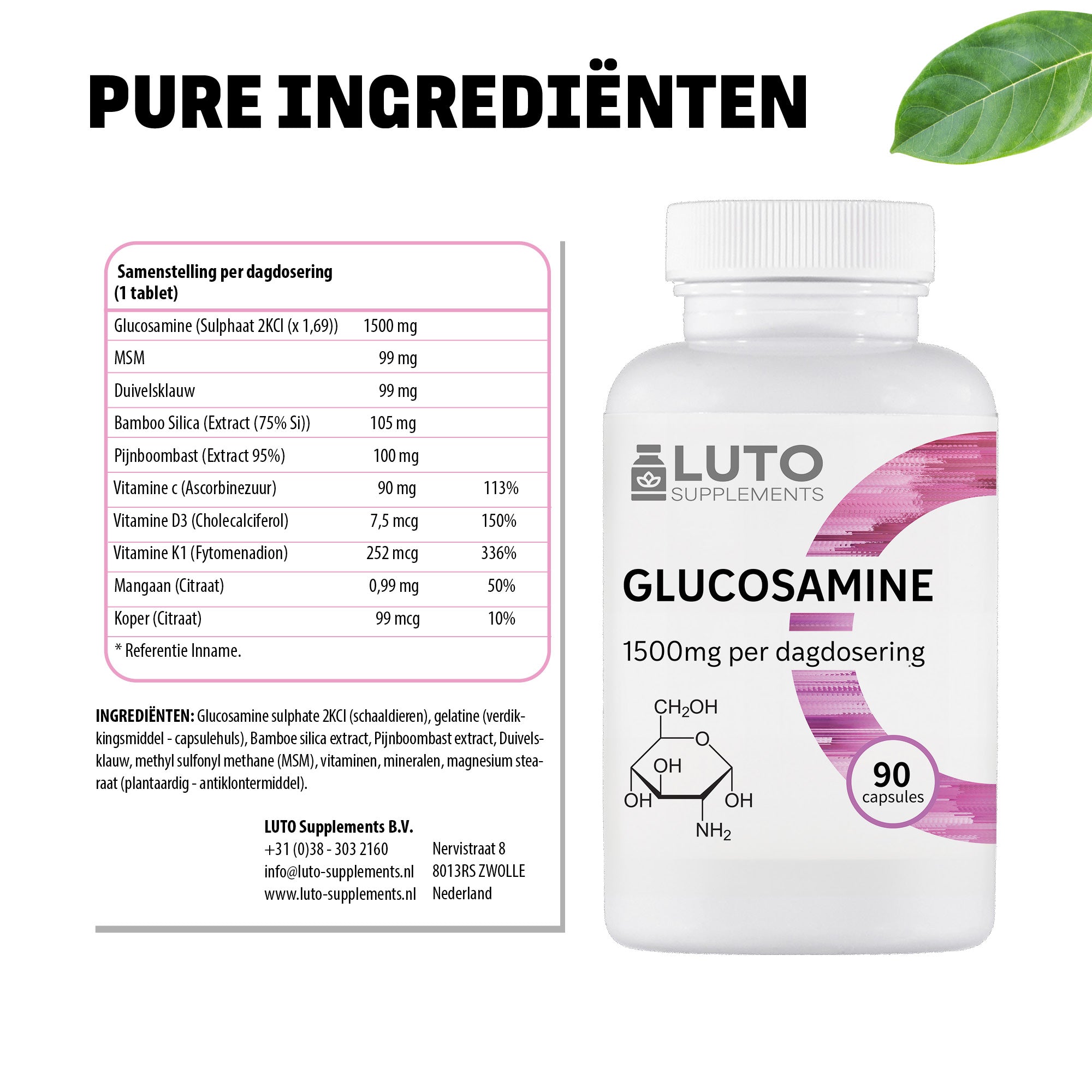
Glucosamin 1500 mg LUTO Supplements – Nährwerte und Inhaltsstoffe auf der Verpackung
Glucosamin 1500 mg LUTO Supplements – Produkt aus der Nähe

LUTO Supplements

Glucosamine 1500 mg | 90 Capsules | LUTO Supplements

Sale price€16,90

In stock. Delivery within 2-3 business days.

Volume discount

Not valid with discount codes.

Specifications

Category Other
Item code luto-050
Barcode 8721055250463
Best before On request
Batch number On request
Content 90 capsules
Number of servings 90

Glucosamine 1500 mg High-Dose Capsules

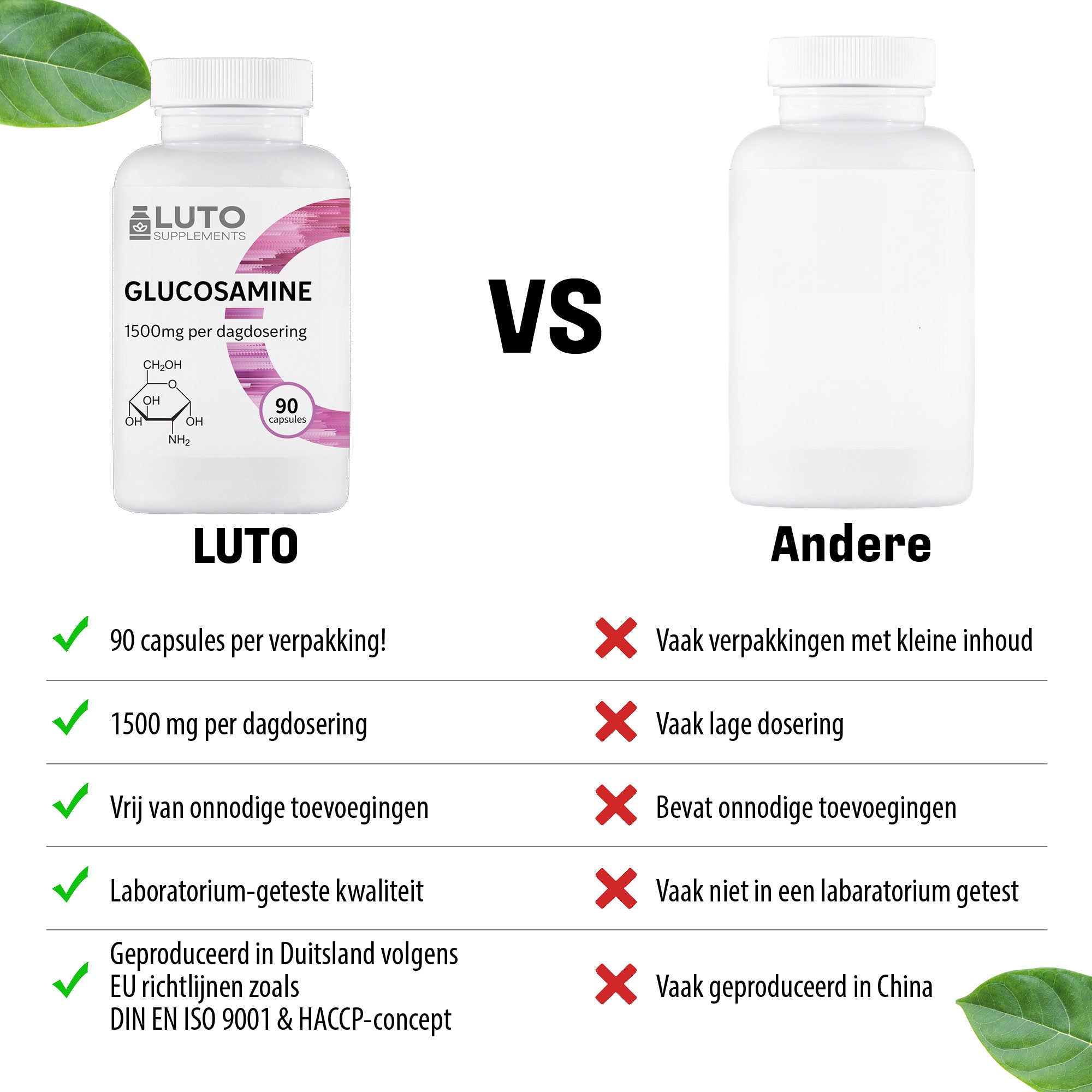
Are you looking for a glucosamine formula that goes beyond pure glucosamine? This product from LUTO Supplements delivers 1500 mg of glucosamine sulfate 2KCl per daily dose (3 capsules), supplemented with MSM, bamboo silica, devil's claw, pine bark extract, and a range of vitamins and minerals. Three capsules a day, that's it. The bottle contains 90 capsules, enough for one month.

What glucosamine sulfate 2KCl actually is

Glucosamine is an amino sugar that occurs naturally in your cartilage and connective tissue. Your body produces it itself, but production decreases over the years. In supplement form, it is usually obtained from crustacean chitin. The addition of "2KCl" in glucosamine sulfate 2KCl refers to potassium chloride, a salt that keeps the molecule stable. This sounds technical, but it boils down to the fact that glucosamine in this form remains well preserved and consistently delivers the same amount of active ingredient. With 1500 mg per daily dose, this product is exactly at the dosage that has been used most frequently in scientific research. This is no coincidence: This amount has been considered the reference dosage for glucosamine dietary supplements for years.

The role of vitamin C with D3 and K1 in this formula

What many people do not know: This formula also contains 90 mg of vitamin C, 7.5 µg of vitamin D3, and 252 µg of vitamin K1. These are not arbitrary additions. Vitamin C contributes to normal collagen formation for normal cartilage function. Collagen is the protein that gives your joints, tendons, and skin structure. Without sufficient vitamin C, this collagen formation runs less smoothly. Vitamin D3 contributes to the maintenance of normal bones, and vitamin K1 does this too. Together they form a trio that fits well with a formula aimed at the musculoskeletal system. Vitamin C also helps protect cells from oxidative stress, which is relevant for tissue that is stressed daily.

MSM with bamboo silica and the rest of the profile

In addition to glucosamine sulfate 2KCl, each capsule contains 99 mg of MSM (methylsulfonylmethane), an organic sulfur compound. Sulfur is a building block for connective tissue structures in your body. Honestly, 99 mg is rather low compared to what is used in research, where dosages of 1500 to 4000 mg are common. Nevertheless, MSM provides an additional sulfur component here alongside the sulfate group of the glucosamine itself. Bamboo silica extract (105 mg, standardized to 75% silicon) is a plant-based silicon source. In addition, the formula contains 99 mg of devil's claw and 100 mg of pine bark extract. This combination makes the product broader than a standard glucosamine capsule.

Why the sulfate form matters

There are different forms of glucosamine. The two best known are glucosamine sulfate and glucosamine hydrochloride. The difference lies in the sulfate component. Sulfate plays its own role: It is involved in the sulfation of cartilage components. In short, glucosamine sulfate 2KCl delivers not only the glucosamine itself, but also the sulfur building blocks that your cartilage needs. This is the reason why this form appears more frequently in clinical research than the hydrochloride variant. LUTO Supplements has opted for this stabilized sulfate form, and that is a conscious choice.

Why Glucosamine 1500 mg from LUTO Supplements?

1500 mg glucosamine sulfate per daily dose

This product provides exactly the daily dose most commonly used in clinical research. Three capsules per day, preferably spread throughout the day.

Sulfate form with additional sulfur building blocks

Glucosamine sulfate 2KCl provides not only glucosamine but also sulfate. This sulfate component is involved in the sulfation of cartilage components. The hydrochloride variant lacks this. That is why glucosamine sulfate is the form with the strongest research basis for joint applications.
Vitamins C, D3 and K1 for cartilage and bones

Vitamin C contributes to normal collagen formation for normal cartilage function. Vitamins D3 and K1 contribute to the maintenance of normal bones. Three vitamins that logically belong in a joint formula, all in a daily dose.

Broad profile instead of just glucosamine

In addition to glucosamine, each daily dose contains MSM, bamboo silica, devil's claw, pine bark extract, manganese, and copper. Most glucosamine capsules on the market contain only glucosamine or glucosamine with chondroitin. This formula covers more building blocks in a daily dose.

Frequently Asked Questions

What exactly is glucosamine sulfate 2KCl?

Glucosamine is an amino sugar that occurs naturally in your cartilage and connective tissue. The "2KCl" designation means that the molecule is stabilized with potassium chloride, a salt that keeps the glucosamine stable and consistent. In practice, this means that after taking it, you simply absorb free glucosamine, while the raw material in the capsule is more stable than unstabilized forms.

What is the difference between glucosamine sulfate and glucosamine hydrochloride?

The difference lies in the sulfate group. Glucosamine sulfate provides sulfate in addition to glucosamine, which is involved in the sulfation of cartilage components. Glucosamine hydrochloride does not contain this sulfate component. In clinical research, glucosamine sulfate is the form that has been studied most frequently and successfully for joint applications. This is why many joint formulas, including this one, opt for the sulfate form.

Why are vitamins C, D3 and K1 also included in a glucosamine formula?

Vitamin C contributes to normal collagen formation for normal cartilage function. Collagen is the structural protein in your joints, tendons and skin. Vitamins D3 and K1 both contribute to the maintenance of normal bones. Together, these three vitamins therefore support both cartilage and bones, which logically fits a formula focused on the musculoskeletal system.

Aren't 99 mg of MSM very low compared to pure MSM supplements?

Yes, that's right. In research, dosages of 1,500 to 4,000 mg of MSM per day are used, so 99 mg is significantly lower. The MSM in this formula is therefore not a substitute for a pure MSM supplement. It is more of an additional sulfur component alongside the sulfate group that is already contained in the glucosamine itself. If you want a therapeutic dose of MSM, you may consider taking a separate MSM product in addition.

How does glucosamine work at the cartilage level?

Glucosamine serves as a building block for glycosaminoglycans and proteoglycans. These are structural components of the cartilage matrix, the tissue that lines your joints. The sulfate component also provides sulfur, which is required for the sulfation of these very cartilage components. In short, glucosamine sulfate provides both the building blocks and the "glue" for the cartilage matrix.

What is the difference between a pure glucosamine capsule and this combination formula?

A standard glucosamine capsule contains only glucosamine, sometimes with a filler. This formula supplements that with MSM, bamboo silica, devil's claw, pine bark extract, vitamins (C, D3, K1), and the trace elements manganese and copper. The advantage is that you take in a broader profile with a daily dose. The disadvantage is that some additives, such as MSM at 99 mg, are dosed lower than if you were to take them separately.