













When do you take L-carnitine?
The label does not specify a particular time, only 1 tablet 1 to 2 times daily. Many people take the tablet with a meal because it is easy to remember. Take it with a glass of water.
Bestsellers
View allBestsellers
View allWinkelwagen
Je winkelwagen is leeg

In stock. Delivery within 2-3 business days.
Not valid with discount codes.
Kies opties
Not valid with discount codes.
Not valid with discount codes.
Each tablet provides 1000mg of L-carnitine, derived from 1493mg of L-carnitine tartrate. NOW Foods uses Carnipure, a branded raw material from Switzerland. One container holds 50 tablets. If you take one per day, it will last seven weeks. Convenient if you prefer swallowing one large tablet rather than two or three small capsules to achieve the same amount.
L-carnitine is a substance that your body produces itself from two amino acids: lysine and methionine. This happens mainly in the liver and kidneys. About 95% of the total carnitine in your body is stored in the muscles, including the heart muscle. The name comes from the Latin carnis, meaning meat, because it was first extracted from meat extract over a hundred years ago. That says something about where you get it from your diet: Red meat is by far the richest source, followed by fish, poultry, and dairy products. Plant-based products contain hardly any of it. So, those who eat vegetarian or vegan diets are largely dependent on their body's own production. A 100-gram steak easily contains 60 to 90mg of carnitine, while a glass of milk contains only a few milligrams. For comparison: This tablet provides 1000mg at once.
Many people wonder what carnitine actually does. In short: It is a shuttle bus. Your cells gain energy from fatty acids, but this combustion takes place in the mitochondria (the powerhouses of your cells). Long fatty acids do not simply pass through the inner wall of a mitochondrion. This is where carnitine comes into play. An enzyme couples the fatty acid to carnitine, after which a transport protein smuggles the whole thing inside. Inside, the fatty acid is detached again and carnitine returns to pick up the next fatty acid. Without this shuttle traffic, long fatty acids remain outside. What many do not know: More carnitine does not automatically mean that the shuttle bus runs faster. The number of transport proteins and your energy requirements also determine the pace.
Carnitine is available in various forms. Here it is bound to tartaric acid as L-carnitine tartrate. The difference to pure L-carnitine lies in stability. Pure carnitine quickly attracts moisture and clumps, making it difficult to press into a tablet. The tartrate form is drier and more stable. That is why you see 1493mg of tartrate on the label for 1000mg of carnitine: The rest is tartaric acid. Carnipure is the brand name of the Swiss manufacturer Lonza, which produces the raw material through fermentation. In this process, only the L-form is created, the variant that your body produces itself. The D-form, which does not occur in the body, is not included. The label recommends 1 tablet 1 to 2 times daily. If you have a thyroid disease, speak to your doctor first, because carnitine can affect the effect of thyroid hormone.
NOW Foods manufactures these tablets in the United States according to GMP guidelines (Good Manufacturing Practice). The tablet has a plant-based coating, which makes swallowing a little easier. Wheat, gluten, soy, milk, egg, and nuts were not used in the production. A simple tablet with a known raw material and a clear amount of L-carnitine: that is what this container is all about.
The L-carnitine tartrate comes from Lonza and is produced through fermentation. This ensures that only the L-form is contained.
One tablet delivers the full 1000mg. So you don't have to swallow two or three capsules for the same amount.
L-carnitine tartrate absorbs significantly less moisture than pure carnitine. This keeps the tablet stable and ensures a long shelf life.
The tablet has a smooth coating. Wheat, gluten, soy, milk, egg and nuts were not used in the manufacturing process.
The label does not specify a particular time, only 1 tablet 1 to 2 times daily. Many people take the tablet with a meal because it is easy to remember. Take it with a glass of water.
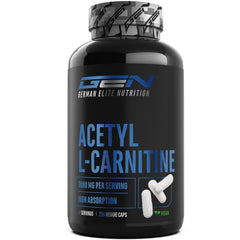
Acetyl-L-carnitine (ALCAR) is carnitine with an acetyl group attached to it. This small change alters how the molecule moves through the body and where it ends up. This tablet contains L-carnitine as tartrate, without an acetyl group.
Vegetarians and vegans get almost no carnitine from their diet because it is found mainly in meat. Their bodies produce it themselves from lysine and methionine. Studies show that their average blood carnitine levels are slightly lower. We are not allowed to say what this means due to EU regulations.
Because the carnitine is bound to tartaric acid. Of the 1493 mg of L-carnitine tartrate, 1000 mg is pure L-carnitine. The rest is tartaric acid, which keeps the raw material stable and dry. So you really do get 1000 mg of carnitine per tablet.
Carnitine acts as a shuttle bus for long-chain fatty acids. An enzyme attaches the fatty acid to carnitine, after which it can pass through the inner wall of the mitochondria. Inside, the fatty acid and carnitine are separated again. The fatty acid is processed, and carnitine returns for the next trip.
Carnipure is the branded raw material of the Swiss company Lonza. They produce L-carnitine through fermentation, which results only in the L-form. Cheaper raw materials are sometimes produced chemically, and then the unwanted D-form has to be removed later. With Carnipure, you know where the raw material comes from.