PEA 600 Palmitoylethanolamide by Vit4ever
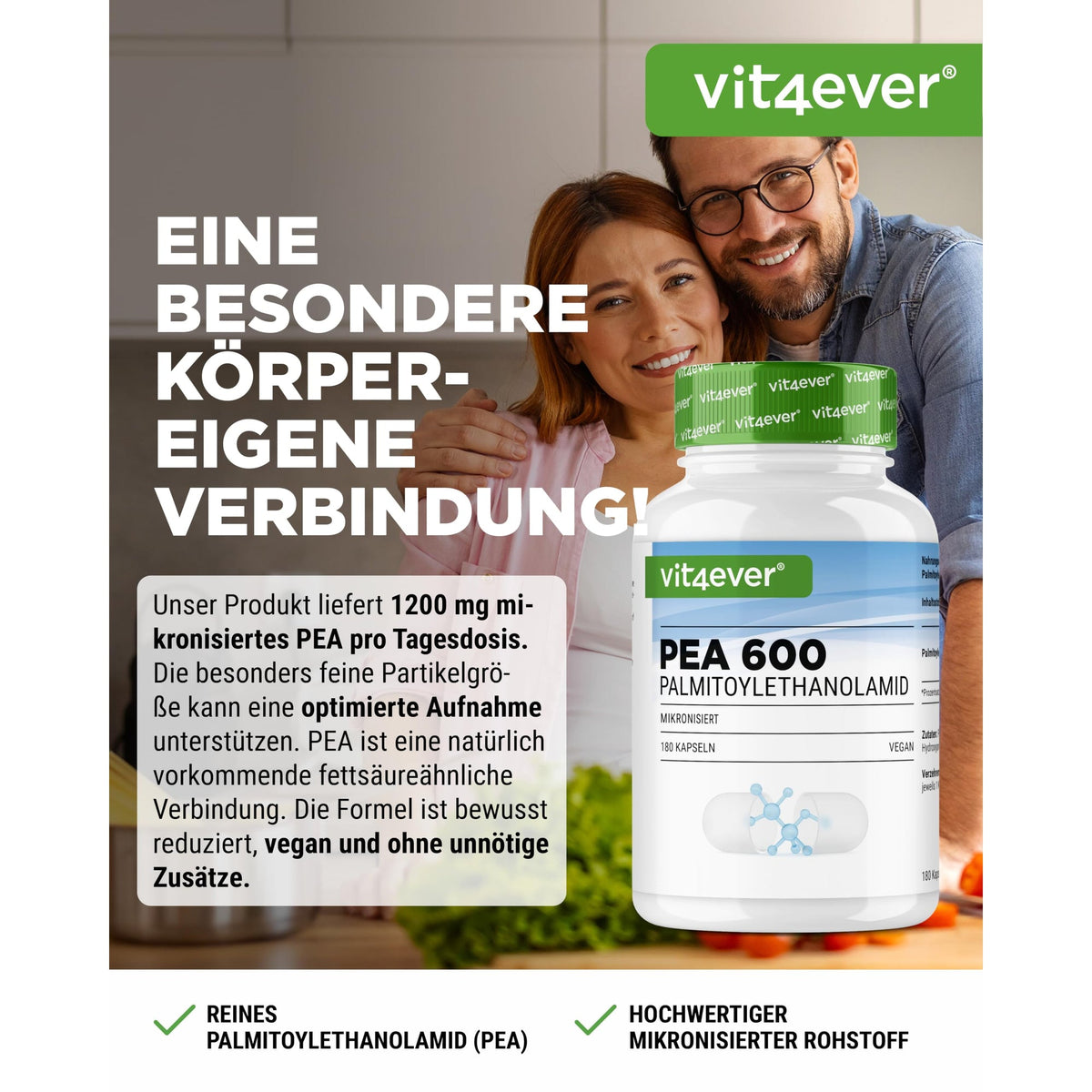
Anyone who reads the ingredients list of this product will see only one name: Palmitoylethanolamide, or PEA for short, an endogenous fatty acid amide that the body produces itself. Vit4ever provides it here without any additives: Each daily dose of two capsules contains 1200 mg of micronized PEA. No fillers, no additional additives, just the raw material itself. Ideal for anyone who wants to know exactly what is in the bottle and wants to add this specific substance to their daily routine.
What Palmitoylethanolamide Exactly Is
Palmitoylethanolamide is composed of two components: palmitic acid and ethanolamine. The body combines these two and produces more of them during times of cellular stress. PEA belongs to the N-acylethanolamine family, the same group as anandamide, a well-known signaling substance in the body. In small amounts, PEA is also found in ordinary food: think of egg yolks, peanuts, soy, and fish. However, these amounts are limited, which is exactly why people choose a concentrated capsule form. What many do not know is that research on this substance dates back to the 1950s. In the 1990s, it received new momentum thanks to the work of Nobel Prize winner Rita Levi-Montalcini, who studied cell biology and signaling substances. Since then, hundreds of scientific publications on PEA have been published across various fields such as cell biology, nutrition, and physiology. Despite this extensive research, PEA is essentially just a fatty acid amide—not an exotic or synthetic molecule, but a substance that is already present in the body.
How the Body Processes PEA
After ingestion, PEA is absorbed in the intestine and distributed throughout the tissues via the bloodstream. Once inside the cell, the substance primarily interacts with the PPAR-alpha receptor, a nuclear receptor that helps determine which genes are read. It can be thought of as a switch deep inside the cell that turns certain processes on or off. PEA is also often described as having endocannabinoid-like properties. The difference between PEA and a true endocannabinoid like anandamide is that PEA itself does not bind to the well-known CB1 and CB2 receptors. Instead, it influences these signals indirectly, an effect researchers call the entourage effect. In short: it interacts with the same network but follows its own pathway. In addition to PPAR-alpha, GPR55 and TRPV1 are also mentioned in the literature as possible targets. PEA is therefore not a substance with a single simple button, but a molecule that plays a role in cell biology on several fronts at once. Researchers call this broad interaction profile one of the reasons why PEA has remained a subject of study for decades.
Why Micronization Makes a Difference
The PEA in this product is micronized, meaning that the crystals have been mechanically ground into particularly small particles. The difference lies in the absorption surface: the smaller the particles, the greater the total contact area with the intestinal wall, and the more easily the body can absorb the substance. Non-micronized PEA consists of larger crystals that do not dissolve as well in the intestine, meaning that part of it simply goes unused. This is also why many manufacturers now deliberately choose the micronized version, even though it costs more to produce. At Vit4ever, there are no intermediate steps: no coating, no carrier substance, just the ground raw material in a capsule. Anyone who has previously tried a non-micronized form will often notice that this provides a different experience, simply because the absorption process is different.
One Ingredient, Nothing Else
What sets these capsules apart from many other products is the simplicity of their composition. They contain only palmitoylethanolamide, with a plant-based hydroxypropyl methylcellulose shell. No magnesium stearate, no anti-caking agents, no colorings or flavorings. Many products on the market contain 400 mg of PEA per capsule; here you get 600 mg, and two capsules a day provide 1200 mg. The capsule shell contains no gelatin, making the product suitable for a vegan lifestyle. With 180 capsules in the bottle, the recommended dosage lasts about three months, making it easier to stick to the regimen without having to order a new bottle halfway through. Good to know: There are currently no official EU dosage guidelines for PEA as a dietary supplement, so the amount you take remains a personal decision, possibly in consultation with a doctor or pharmacist.
Pure palmitoylethanolamide, generously dosed and without unnecessary additives: that is essentially what these capsules offer. For anyone looking for this specific raw material in its purest form, without additives or extras, this is a logical choice for the supplement cabinet.